RSS

The 2023 Housing Market was Defined by High Rates and Slow Sales

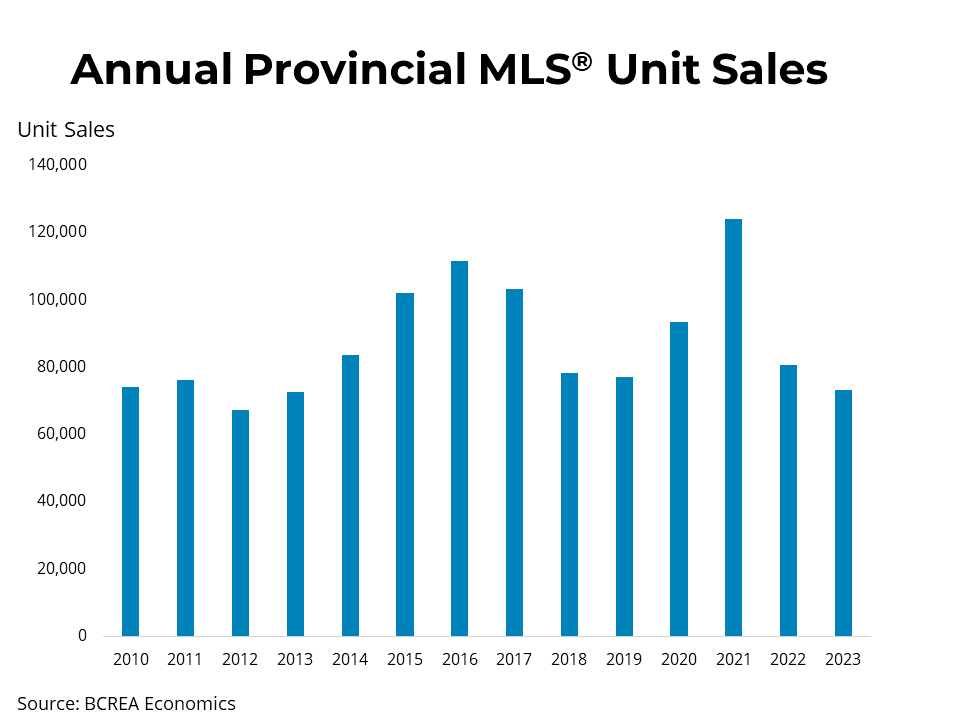
Vancouver, BC –  January 15, 2024. The British Columbia Real Estate Association (BCREA) reports that 73,109 residential unit sales were recorded by the Multiple Listing Service® (MLS®) in 2023, a 9.2 per cent decline from 80,506 units sold in 2022. The annual average MLS® residential price in BC was $971,144, a 2.6 per cent decrease from $996,943 recorded the previous year. Total sales dollar volume was $71 billion, an 11.5 per cent decline from 2022.

chart

“The highest mortgage rates in over 15 years led to the slowest sales in a decade for BC,” said BCREA Chief Economist Brendon Ogmundson. “With mortgage rates falling to start the year and the potential for Bank of Canada rate cuts on the horizon, the outlook for 2024 appears much brighter.”

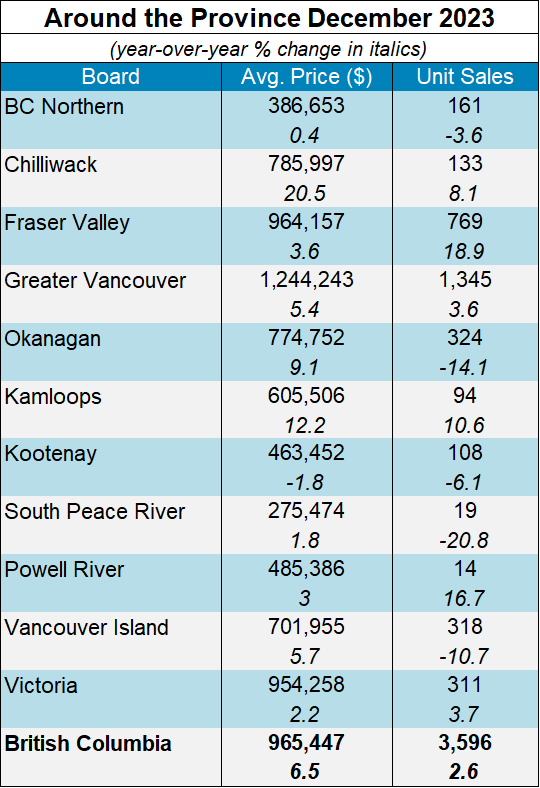
A total of 3,596 residential unit sales were recorded in Multiple Listing Service® (MLS®) systems in December 2023, an increase of 2.6 per cent from December 2022. The average MLS® residential price in BC was $965,447 a 6.5 per cent increase from $906,356 recorded in December 2022. Total sales dollar volume was $3.5 billion, a 9.3 per cent increase from the same time last year.

table

source

Read

B.C. property assessments show home values have stabilized after years of big gains

The assessed value of properties in B.C. has stabilized on average, with some outliers such as Lytton, Haida Gwaii and Tumbler Ridge recording big jumps in worth.


According to statements released Tuesday by the B.C. Assessment Authority, property values as of July 1, 2023, changed on average between minus 10 per cent and plus five per cent.


In the Lower Mainland, the range was between minus five per cent and plus five per cent.


“Across the Lower Mainland and throughout B.C., the overall housing market has generally stabilized in value,” said B.C. Assessment’s lead assessor, Bryan Murao.


“Most homeowners can expect only modest changes in the range of minus five per cent to plus five per cent. These assessment changes are notably less than previous years.”


For example, the average detached home in Vancouver rose in value nine per cent in 2022 and 16 per cent in 2023.


“Commercial and industrial properties are generally increasing in value at a higher rate than residential, especially in areas such as the Fraser Valley where properties are up in value as a result of limited industrial land,” Murao said.

Andy Yan, the director of Simon Fraser University’s City Program, said the flattening of prices was due primarily to the Bank of Canada’s policy over the past two years of raising interest rates as a way to cool inflation.


Yan also noted that the recent assessments were made on July 1, 2023, before the provincial government introduced legislation forcing municipalities to allow densification, a move that will likely impact prices moving forward.


“The new legislation may not necessarily immediately lead to increased values, but set a floor of pricing expectations that current owners are reluctant to leave,” he said, noting 41 per cent of home owners in Metro Vancouver do not have a mortgage.


Realtor Steve Saretsky agreed that the jump in interest rates had led to stalled property values. He said that since July 1, 2023, the housing market had further softened but could pick up this spring if the Bank of Canada brings its benchmark interest rate down.


For the Lower Mainland region, the overall total assessments values increased from about $1.94 trillion to nearly $2 trillion.


Almost $27.2 billion of the region’s increased assessments is from new construction, subdivisions and the rezoning of properties. B.C. Assessment’s Lower Mainland region includes all of Greater Vancouver and the Fraser Valley, as well as the Sea to Sky area and the Sunshine Coast.


At the top end, for a single-detached home, assessed values went up four per cent in Vancouver, Burnaby and Coquitlam. The average detached home’s value in Vancouver is now $2,209,000.


The average assessed value of a detached home in Surrey didn’t budge, sitting at $1,609,000. The worst performer in the region was the District of Hope, which had a 13 per cent decline in assessed value with an average detached home now worth $611,000.


The value of a detached home in Hope rose 14 per cent last year, and 45 per cent the year before during the COVID-19 real estate boom when buyers were seeking properties outside the city.


In a big change over last year, the average assessed value of a detached home in Whistler went down two per cent and is now $2,842,000. Last year a detached Whistler home rose in value 11 per cent, and 29 per cent the year before.


When it comes to the strata property class (condos and townhouses), the best performer in the Lower Mainland was Richmond, where the average condo went up in value four per cent to $779,000.


Vancouver Island had the same range of movement in assessed value as the Lower Mainland — between minus five and plus five per cent.


However, this was skewed by a very strong performance in the north of the island that outweighed an overall decline in value across Greater Victoria and the Central Island.


Figures shows a drop in value in all Greater Victoria’s 14 assessment regions, with detached homes in Colwood and Esquimalt falling three per cent.


In the Central Island, on average a detached home in Lake Cowichan fell nine per cent, while the drop was four per cent in Ladysmith.


In the North Island, a detached home in Port Alice rose 34 per cent, Port McNeill 15 per cent, Alert Bay 20 per cent and Tahsis 10 per cent.


Vancouver Island deputy assessor Matthew Butterfield said the large increase in values in smaller North Island communities was due to strong demand and lack of supply.


Southern Interior deputy assessor Boris Warkentin said that his region had value changes somewhere between minus 10 per cent and plus five per cent. Kelowna, Penticton, Summerland, Princeton and Salmon Arm all had a drop in the assessed value of a detached home, while those values rose in Armstrong, Vernon and Coldstream.


Warkentin said the value of properties in the fire-ravaged community of Lytton rose 26 per cent due to increased market activity.


Northern B.C. had a similar rate of change as the Southern Interior, with the exception of Haida Gwaii (increase 22 per cent) and Tumbler Ridge (increase 19 per cent).




Read

Bank Of Canada To Drop Interest Rate To 2.25% By 2025: TD

The Bank of Canada (BoC) will drop its policy interest rate to a much more attractive 2.25% by 2025, according to a recent forecast from TD.

The long-term forecast, written by TD CFA James Orlando and Director Thomas Feltmate, predicts that inflationary pressures will ease over the medium term, allowing the central bank to cut its policy rate back to the neutral rate of 2.25%.

This would cut the interest rate, which currently sits at 5%, by more than half — a move that would be extremely welcomed by borrowers saddled with, in many cases, prohibitively high mortgage payments.

In recent months, borrowers have increasingly struggled with affordability. Would-be homebuyers have moved to the sidelines, either unable to qualify for a mortgage or voluntarily holding off until interest rates comes down. As a result, home sale numbers have dropped in major markets all across the country.

Those already holding a mortgage, however, are greatly feeling the pain. A recent survey from Zolo found that nearly half of Canadian mortgage holders are worried about their mortgages renewing at much higher rates. Another TD report released earlier this month found that by the end of 2023, nearly 50% of all mortgage holders will see their monthly payments increase in comparison to February 2022 — the month before the Bank of Canada (BoC) embarked on its rate hike campaign. By the end of 2024, that share rises to 65%. The average mortgage holder is expected to see their monthly payments increase by nearly 30% by the end of 2024.


The Canada Mortgage and Housing Corporation (CMHC) is similarly bracing for borrowers facing difficult payment increases, with new research finding that homeowners renewing their mortgages over the next two years could see a 30% to 40% increase in their average monthly payments. On a $500,000 mortgage with a five-year fixed-rate term and a 25-year amortization period, for example, a rate increase from 1.94% to 5.45% would result in a $950 jump in their monthly payments.

A bright spot for those having to renew is that some mortgage terms have already fallen below the 5% interest rate mark. Around mid-December, some institutions like Equitable Bank, THINK Financial, and MCAP began offering five-year insured fixed-rate mortgages at slightly more appealing rates. This shift towards lower rates is due to the bond yield market — which fixed rates are based on — cooling over the past month.


But as higher rates continue to weigh on borrowers, TD found that mortgage holders have pulled back their spending by approximately 1% compared to those without a mortgage, resulting in a $6B reduction in spending across the economy. In the absence of higher mortgage rates, TD said growth in real consumer spending would have come in at approximately 1.9% year over year in Q3. Instead, it came in at 1.5%.

In their forecast, TD predicts that inflation will end the year at an annual rate of 3.8% before falling to 2.7% in 2024, 2.1% in 2025, and 2.0% in 2026 — the BoC's target for inflation. After hitting a 40-year high of 6.8% in 2022, inflation has come down quite a bit this year, signalling good news ahead for Canadian spenders.

source

Read

Why the Bank of Canada could cut interest rates much more than markets expect

The Bank of Canada is widely expected to hold its benchmark interest rate when it meets next week, but a lot has changed since October.

Article content


Cooling inflation, here and south of the border, and a weakening economy have turned markets’ attention from rate hikes to rate cuts.


Investors are now fully pricing in a 25 bps rate cut by April, a 75 per cent chance by March and even a 20 per cent chance by next week.


Stephen Brown, deputy chief North American economist for Capital Economics, thinks odds of a cut as early as next week are way off the mark, but also believes markets are underestimating the degree of policy loosening to come in 2024.


Capital expects the Bank will tone down or even drop its tightening bias next week because of developments since its last meeting in October.


Oil prices, a big driver of inflation, have fallen back after a spike over the Israel-Hamas war to below what the Bank forecast in its October monetary policy report. Gas prices are at their lowest since March.

Article content


Capital now expects that headline inflation will average 3.1 per cent this quarter compared to the Bank’s forecast of 3.3 per cent.


The economy is also looking weaker than the Bank expected, said Brown. Gross domestic product data out today showed the economy in the third quarter shrank at a 1.1 per cent annualized pace, weaker than the Bank’s forecast of 0.8 per cent.


Other indicators support this. “According to the CFIB Business Barometer, the share of firms suffering from insufficient domestic demand jumped to 44 per cent in October, which implies that GDP is close to 1.5 per cent below its potential,” said Brown.


He also expects that jobs data out tomorrow will show a small rise in unemployment and slowing wage growth, “which should help to soothe the Bank’s lingering fears about wage pressures.”

Article content


Despite some tough talk on inflation, Bank of Canada governor Tiff Macklem “has now dangled the prospect of rate cuts a few times,” said Brown.


The governor repeated last week that cuts can begin before inflation falls to the 2 per cent target as long as there is a clear trend that it is headed that way.


Capital estimates that the Bank will need to see this trend for almost six months, making March or April the most likely meetings for cuts to begin.


But while markets expect only 95 bps of cuts over 2024, Capital believes the Bank will need to cut more than twice as much.


“The main reason we disagree with market pricing is that, based on our inflation forecasts, 100 bp of cuts would not be enough to prevent the real stance of policy from becoming more restrictive,” said Brown.

Article content


“In other words, the Bank will need to deliver 200 bp of cuts just to prevent monetary policy weighing even further on economic growth.”


One sticking point could be the housing market. While home prices are coming down, the Bank may take a more cautious approach to avoid fuelling another rally.


Yet, the sales-to-new listing ratio recently fell to its lowest since 2013, meaning that home prices could drop even more than the 5 per cent Capital is predicting by March.


“At a time when house price declines are gathering pace, … right now one can just as easily make the opposite argument that the Bank will need to act aggressively to prevent the housing market from falling into a tailspin,” he said.


Consumer credit has slowed to its slowest pace in 30 years, and when adjusted for inflation National Bank economists estimate that it has actually fallen by 1 per cent. The last time household credit fell in Canada it was the great recession of the 1990s, which the prime rate hit 14 per cent and the jobless rate was 12 per cent, said National economist Stéfane Marion.


“There is simply no precedent for a contraction in household credit of the current magnitude, while the unemployment rate remains below 6 per cent,” wrote Marion.


“Let’s hope that the next employment report on Friday doesn’t show too much of a deterioration in hiring, otherwise the credit cycle will continue to deteriorate.”

Source

Read

Consumers overestimating how low, and how fast, interest rates will fall: economists

With interest rates likely at or near their peak in Canada, experts say consumers shouldn’t expect rates to return to pre-pandemic levels.

The central bank is more likely to bring its overnight rate to between two and three per cent, though not anytime soon, said David Macdonald, senior economist with the Canadian Centre for Policy Alternatives.

“That’s a ways off. That’s not next year,” he said, adding that consumers may not have fully grasped this yet.

The Bank of Canada on Wednesday held its overnight rate at five per cent, after a breakneck tightening cycle from near-zero in March 2022. The overnight rate affects interest rates offered by financial institutions. 

The Bank of Canada’s overnight rate was 1.75 per cent throughout 2019, before the central bank dropped it to a quarter of a point to support the economy during the onset of the COVID-19 pandemic. 

The central bank is widely expected to hold rates high in the near term as it seeks to quell inflation. But even once rates begin to fall, economists said ultralow rates aren't in the cards.

The Canadian economy, and consumers along with it, is going through an accelerated paradigm shift, said TD chief economist Beata Caranci -- less a gradual shift than a cold glass of water to the face. 

Caranci thinks Canadians are aware that interest rates aren’t going back to pre-pandemic levels, but she also thinks they’re too optimistic about when, and how fast,rates will go down. 

Borrowers have been increasingly opting for shorter terms on their mortgages, hoping rates will be lower in a year or two, she said.

Thatmay well happen, but it’s not a guarantee, she said.

“If you look at our forecast, if you look at the consensus on the street ... Most people have some cuts coming in by the second half of next year. But that's presumed that the economy is weaker than it is today,” said Caranci. 

“One of the points I've been stressing with our clients is, the speed at which rates went up will not be the speed at which they go down.” 

In a report Wednesday, CIBC Capital Markets chief economist Avery Shenfeld said the central bank will likely be able to ease its overnight rate to 3.5 per cent by the end of next year. 

A term that’s often used to describe where the overnight rate may go -- or where it should go -- is the neutral rate. That’s essentially the “Goldilocks” of the central bank’s rate, explained Caranci: “It's an interest rate that allows the economy to grow neither too hot or too cold.”

In an Oct. 5 report, Caranci and senior economist James Orlando wrote that they believe the neutral rate in the U.S. is on the rise due to factors like climate change investment, changing supply chains and higher government deficits. 

“A higher neutral rate means that the current policy rate may not be as restrictive as the (U.S. Federal Reserve) thinks,” they wrote.

A similar trend is at play in Canada, according to Caranci and Orlando, but Canadian consumers' high debt levels mean a lower neutral rate north of the border. 

Prior to the pandemic, rates in Canada and globally had been historically low for years, said Macdonald -- because inflation had been low for decades. 

Rates were as low as half a percentage point during the past decade, including for a two-year stretch between July 2015 and July 2017. Over the past 10 years, the average overnight rate was 1.27 per cent. 

There are downsides to having very low rates, said Macdonald, including the fact that when recession hits, the central bank has very little room to stimulate the economy by lowering rates further. 

Over the years, low rates also contributed to a housing boom, he said. The Bank of Canada’s mandate is to keep inflation in check, Macdonald said, but home prices aren’t included in the Consumer Price Index. 

The seasonally adjusted average price of a home in September was $669,689, according to the Canadian Real Estate Association, a 70 per cent increase from $392,647 a decade earlier and a 216 per cent increase from $211,893 in September 2003. 

This “explosion” in home prices drove substantial wealth inequality over time, said Macdonald, as anyone lucky enough to have their foot in the door at the right time saw their wealth grow, while others were left behind. 

He agrees that Canadians are now in a “difficult period of adjustment,” where household budgets are being eaten up by mortgage costs, rent is on the rise and house prices are expected to moderate. That adjustment has really just begun, he said. 

“We’ve still got a long way to go at these much higher interest rates and much higher inflation.”

-- With files from Nojoud Al Mallees

This report by The Canadian Press was first published Oct. 27, 2023.

source


Read

Most of Canada’s New Condos Are (Still) Investor Owned: Stat Can

Real estate speculation is a national sport in Canada, but it may have gone over the line. The Statistics Canada (Stat Can) Canadian Housing Statistics Program (CHSP) released data showing the share of newly constructed condos owned by investors in 2021. The data reveals that most units are investor owned, amplifying concerns of financialization and ownership concentration. Both issues lead to inefficient markets that aren’t just difficult for the public, but increase vulnerability in the event of an economic downturn. 

Canadian Real Estate Investor Market Share & Commoditization

Canada has seen the rapid financialization of housing, and that can be an issue. “In the context of housing affordability, concerns about financialization and the concentration of ownership in the real estate market have emerged in recent years,” wrote the CHSP, in the accompanying notes with the data.  

Financialization is when housing is treated as a commodity to trade, rather than serving a need. Everything is commoditized to some degree, but the deeper the financialization the less connected the asset becomes to its use. 

In the case of housing, rather than landlords collecting rental yield, they may start trading the homes as speculative properties detached from any value. That can lead to rents that are no longer connected to incomes, resulting in greater social liabilities. Greater social liabilities tend to produce greater corrections. 

Concentration of ownership can also present a concern when it comes to essentials. A greater share of investors that trade based on financialization, the more distorted markets become. When housing is treated as a commodity disconnected from its need, it’s prone to more violent economic corrections. It’s a problem that was prominent during the Golden Age of Colonialism, and it’s popping up again. Once again, the more disconnected the worse the correction.

Most of Canada’s New Condo Supply Is Investor Owned

Most of Canada’s new condos continue to be investor owned, driven by larger provinces. Investors owned most condo units built after 2016 in Ontario (57.3%) and Nova Scotia (58.8%). It wasn’t quite half in BC (49.3%), but it got closer. Most of Canada’s new supply has been delivered in these provinces, meaning it skews ownership across the country. 

Investors Own Most of Canada’s New Condo Supply

The share of condos built after 2016 that are owned by investors.

*CA includes the five provinces with data from the CHSP. They will be gradually adding more provinces in the coming months.

Source: Stat Can; Better Dwelling

Only two of the tracked provinces have seen major declines in the share of investor-ownership. New Brunswick saw the share of investor owned new condos drop 18.7% to 31.3% in 2021. Manitoba wasn’t as extreme, but still saw a big 9.9% decline to 39.4% of new condos.   

Most housing built after 2016 is investor owned, presenting an ownership concentration issue. The issue becomes even more problematic when you consider this is the share of owners that kept the unit as an investment. Virtually all pre-construction is sold to investors in major markets, distorting them even further.

Read

Government of Canada "Actively Examining" Action On Short-Term Rentals

The jury is still out on whether British Columbia's recently announced actions against illegal short-term rentals will have their desired effects, but it's now received a big endorsement from Minister of Finance and Deputy Prime Minister Chrystia Freeland, who says the federal government is following suit.

At a joint press conference with Minister of Innovation, Science, and Industry François-Philippe Champagne and Treasury Board President Anita Anand on Tuesday, Freeland announced that she was designating the Ombudsman for Banking Services and Investments (OBSI) as the single external complaints body for Canada's banking sector.

She then closed her remarks by shouting out British Columbia.

"I also want to quickly address the BC government's new legislation to regulate the short-term rental market," said Freeland. "This is a positive and important step in the right direction, in an area of provincial jurisdiction."

Freeland then said what many governments around the world have said: short-term rentals need to be converted into long-term rentals.

"We know that short-term rentals through sites like Airbnb and Vrbo mean fewer homes for Canadians to rent and live in full-time, especially in urban and populated areas of our country," she said. "That is why our government is actively examining what options and tools exist at the federal level, to ensure more short-term rentals are made available as long-term rentals — as permanent homes — for Canadians to live in."

Freeland concluded by saying that the Government of Canada will have more to announce in the weeks to come.

The War On Short-Term Rentals

A day prior to Freeland's comments, the Province of British Columbia announced the Short-Term Rental Accommodations Act, which included a suite of actions such as creating a provincial registry for platforms and hosts, increasing fines for infractions, and requiring platforms to share more data.

With the announcement, BC joined a growing list of governments around North America that are cracking down on short-term rentals in the name of alleviating pressures on their respective housing markets. That list includes Barcelona, Vienna, and New York City, among others. In Canada, both Quebec and Halifax recently announced actions as well.

It's unclear what the Government of Canada can really do, however, as short-term rentals are an area of provincial jurisdiction, rather than federal jurisdiction — a reality Freeland acknowledged on Tuesday. Despite that, Freeland said housing is such a big issue that the federal government is looking at everything.

"It is so important that we are examining whether there are any tools in the federal jurisdiction that we could use, that would make a difference in this space," Freeland said. "And the reason we're so focused on it is we really do understand that housing is a very challenging issue for Canadians, and we believe that the core challenge is that there just aren't enough homes available for people to buy or for people to rent, so we're reviewing the space and we're thinking 'what can we do in both the medium-term and immediately to relieve some of the pressure."

She went on to cite an estimate that 30,000 units of housing could be added back to the market in just Vancouver, Toronto, and Montreal if action were to be taken.

"That would make a big difference," she said. "And that's why, recognizing — as we do — that this is in provincial jurisdiction, we are taking a very careful look at whether there are any tools in the federal toolbox we could use as well. But if other provinces want to follow BC's lead, that would be great for Canadians, too."

Source

Read

B.C. government orders 60,000 new homes built in 10 municipalities the next five years

The B.C. government has ordered 10 of the largest municipalities in the province to build more than 60,000 new units of housing over the next five years — or face consequences.

Housing Minister Ravi Kahlon announced the exact numbers for net new units in the 10 municipalities on Tuesday, months after the province first said those communities would be targeted as part of the government's push for additional housing supply. 

"We're taking action and working with municipal partners to make sure more homes are built in communities with the greatest housing need," said Kahlon in a statement.

"The targets include thousands of below-market rental units for the largest and fastest-growing communities. This means more people will be able find a home in the community they love."

The 10 municipalities are Vancouver, Victoria, Kamloops, Abbotsford, Delta, Saanich, North Vancouver District, Port Moody, Oak Bay and West Vancouver.

Overall, the number of units they're being asked to add to their housing stock in the next five years ranges from 28,900 in Vancouver to 664 in Oak Bay — but when adjusted for population, all 10 would see an increase of units between eight and 14 per cent by 2028. 

In addition, the province has put in place separate sub-targets for each municipality by year, by whether the units are rentals or ownership, by whether the rentals are market or below market, and by number of bedrooms. 

If municipalities fail to meet their targets, the government has said they retain the option of appointing an adviser or issuing a directive that could usurp the traditional jurisdiction of municipalities to oversee land use within their boundaries. 

Eby in Ottawa

Kahlon said the 10 chosen communities were selected through "an objective, thorough and measured process" that factored in metrics, including projected growth, housing and land availability, affordability, community infrastructure and "unrealized potential in developing more homes."

Premier David Eby, who has spent two days in Ottawa meeting with federal ministers and Prime Minister Justin Trudeau, says affordable housing would be made available quicker with the co-ordination of all levels of government.

He says the federal ministers were receptive to that pitch.

Eby's trip to Ottawa comes after the federal government announced a $4 billion Housing Accelerator Fund in its 2022 Budget that would provide incentive funding to local governments to encourage initiatives that lead to new housing supply.


"My understanding is the federal government is close to being able to make announcements in terms of the allocation of that funding to support growth in cities, which is very good news," Eby told reporters Tuesday.

"The challenge or the opportunity, I guess, is to co-ordinate that municipal accelerator program with the cities that our housing minister has been working with on housing targets."

The premier said he also made "very good progress" in advancing the interest of B.C. residents in his meetings with the federal ministers, noting he is "particularly happy" with his discussions around how the federal and provincial governments can work together to support the clean energy sector.


Source

Read

Coquitlam Approves Increases To Development Cost Charges

The City of Coquitlam has approved increases to its rates for development cost charges (DCCs), increasing the price to build in a municipality that's become very popular among developers in recent years.

In Coquitlam, development cost charges are levied on all development applications with a construction value below $150,000, and the City uses the revenue to help pay for expanding necessary infrastructure, including transportation, water, sewage, drainage, and parks.

Development projects that require rezoning are also subject to community amenity contributions (CACs), but DCCs for non-residential projects are very low, so as to not hinder economic growth.

Like many other municipalities, the City of Coquitlam reviews its DCCs regularly and adjusts the rates in order to reflect the economy and growth trends. As part of this process, the City is now raising all of its DCCs by 4.5%, reflecting the 4.5% increase in the Vancouver Consumer Price Index published by Statistics Canada in April 2023.

Following the increase, the total DCC for single-detached homes is now at $63,141 — by far the highest of any type of development. Multiplex housing forms have a total DCC of $41,448 per unit, followed by rowhouses and townhouses at $37,418 per unit, and then multi-family complexes at $23,715 per unit.

"While this increase is below the construction cost escalations observed over the past year estimated at 10%, it helps the City's rates to keep up with the inflationary cost increases in the region," staff said in a recent report.

The 4.5% increase is relatively modest when compared to other municipalities. In Vancouver, rates for DCCs were set to increase by 8.3%, until Council opted to defer the increase until 2024 in order to avoid further worsening project viability for developers.

Earlier this year, the City of Surrey also increased its rates for DCCs, by 9.3%, which are now in effect. Although Coquitlam's increase of 4.5% is much lower, the actual DCC is higher in some cases. In Surrey, the total DCC charges for non-multi-family homes do not exceed $53,154. DCCs for multi-family homes are then charged according to square footage rather than per unit like in Coquitlam.

Coquitlam City Council granted a first, second, and third reading to the bylaw amendment earlier this month, before granting a fourth and final reading Monday evening.

Applications that are currently in progress will be protected, and the new rates will come into effect on Sunday, October 1.

Source

Read

Tax wealthy homeowners to fund affordable housing, says new B.C. proposal

To improve affordable housing, a B.C. economist says the province needs a more progressive property tax system — one that raises levies on high-value properties and people who own multiple homes.

Such a policy, says Alex Hemingway, will raise billions of dollars for public housing projects while simultaneously dampening home price growth over the long term.

The policy proposal, laid out in a white paper published Wednesday with the Canadian Centre for Policy Alternatives of B.C., comes as residential property values have grown a “staggering” $1.7 trillion over the past two decades, leading to greater inequality among those who own a home and those who don't, says Hemingway.

“In terms of addressing the inequality that’s been created, that’s really where property tax comes front and centre,” Hemingway told Glacier Media in an interview.

Because property tax reform is both complex and contentious, Hemingway is calling on a citizen’s assembly to discuss options.

12% of B.C. households would pay more, says economist

Hemingway's proposals largely focuses on greater taxes on the priciest properties in B.C., but also reforms along the edges, such as greater emphasis on taxing land and not buildings, as a way to incentivize denser forms of housing.

To raise an extra $580 million annually, Hemingway proposes doubling the existing provincial property surtax on residential properties valued above $3 million (to 0.4 per cent) and $4 million (to 0.8 per cent), as well as adding a new bracket above $7 million (1.5 per cent).

To raise even more money, Hemingway suggests the provincial government apply extra property taxes on owners of multiple homes and properties valued at over $1.5 million. In such a scenario, just 12 per cent of B.C. households would pay more, adding about $2 billion for public housing projects.

That surtax, known as the Additional School Tax, was brought in by the BC NDP government in 2019 and is opposed by the opposition party, BC United.

“The B.C. government has taken some important but limited steps in recent years when it comes to taxing residential property wealth,” said Hemingway.

Lack of public investment adding to cost-of-living crisis

Hemingway said the existing surtax is a “drop in the bucket,” compared to recent gains in property values, which currently climb around $223 million annually.

Despite political opposition, Hemingway says polling shows high public support for taxing the wealthy.

“People recognize [higher home values] has been a stroke of luck, and it’s unintentionally come at the expense of others. And that’s corrosive on our social fabric,” said Hemingway.

Hemingway says public spending as a percentage of GDP has declined over the past generation.

“That lack of public investment has contributed to some of the cost-of-living crisis we’re seeing. And that’s why it’s sensible to be thinking about raising additional revenue,” he said.

Hemingway further proposes more complex changes to the current property tax scheme. By shifting tax away from buildings to the land itself, the government could incentivize building denser forms of housing, which Hemingway supports.

Hemingway says it’s also worth considering a consistent property tax rate, as opposed to having it fluctuate (historically downward) to align with government budgets.

“A first step would be to stop automatically cutting provincial property tax rates when property values rise faster than inflation. Holding rates steady wouldn’t raise much revenue initially, but if property values continue escalating, it would raise revenue and ensure more land value gains are captured for the public good,” wrote Hemingway.

To address declining property values, Hemingway suggests a rate floor, especially in regions where home prices are extremely out of line with local incomes.

Hemingway says governments may also want to consider expanding property tax payment deferrals until a property is sold. Currently, the deferral program only exists for homeowners over age 55 and families.

Under a higher property tax scheme, Hemingway said “we may want to expand and if not universalize that option.”

At the heart of Hemingway’s proposal is an effort to disincentivize housing, or land, as an asset class.

Open to 'tax shift' proposal to lower burden on low and mid-level earners

While not including it in his proposal, Hemingway says he supports a plan backed by the think-tank Generation Squeeze that would lower income and sales taxes to offset any hike in property taxes.

The plan seeks to cut provincial income tax on the first $30,000 an individual earns. B.C.’s second income tax rate would be eliminated, leaving earnings from roughly $40,000 to about $79,000 taxed at the rate of 5.06 per cent rather than 7.7 per cent. Furthermore, British Columbians would pay a provincial sales tax between five and seven per cent — all in exchange for a property surtax on properties valued at over $1 million.

“Right now we shelter housing wealth, especially high housing wealth, from taxation and we disproportionately draw on income taxation, including from middle and lower income renters, who aren’t benefiting from massive housing wealth growth,” said Paul Kershaw, a professor in public health at the University of British Columbia and head of Generation Squeeze.

Kershaw says his “tax shift” proposal — aimed at addressing generational wealth inequities — is needed to pay for the growing social and health needs of an aging population. For that reason, he said it only makes sense to draw revenue from that source, which happens to own much of the land in the province.

Source

Read
Reciprocity Logo The data relating to real estate on this website comes in part from the MLS® Reciprocity program of either the Greater Vancouver REALTORS® (GVR), the Fraser Valley Real Estate Board (FVREB) or the Chilliwack and District Real Estate Board (CADREB). Real estate listings held by participating real estate firms are marked with the MLS® logo and detailed information about the listing includes the name of the listing agent. This representation is based in whole or part on data generated by either the GVR, the FVREB or the CADREB which assumes no responsibility for its accuracy. The materials contained on this page may not be reproduced without the express written consent of either the GVR, the FVREB or the CADREB.